
PBI’s Support Provides a Sense of Safety
By Amna Khalafalla, PBI-USA Solidarity Fellow
In countries like Colombia, Peace Brigades International’s protective accompaniment model has worked to provide a sense of safety to human rights defenders whose work has put them at extreme risk and danger. Jani Silva, a Colombian environmental defender, is one of them.
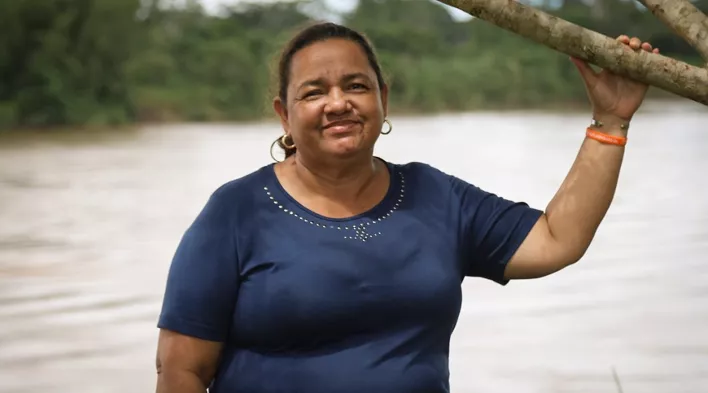
Born in Leticia, Amazonas, Jani and her family left when she was five and was 12 years old when they settled in Putumayo. Jani had a natural ability for public speaking and became fond of this work, so she accepted the leadership roles the community appointed her to, including organizing the community and demanding their rights to life, to the territory, to health, to education, to the protection of life in the countryside. Jani took on that role and led the community’s efforts in the 1990s, during a particularly challenging time for Putumayo.
Located in the Amazon Pearl in the heart of the Amazon, Putumayo is a region rich in biodiversity and natural resources with which communities have intertwined their livelihoods. The region has suffered from the social and environmental effects of extractivism including armed groups enforcing coca production, exposure to fumigation, and deforestation.
To preserve her community’s livelihood, Silva, who leads the Integral Sustainable Development of the Pearl Amazónica (ADISPA) as its president, led a campaign to form the Pearl Amazon Peasant Reserve Zone (ZRCPA), a protected peasant farmers zone established at the end of 2000. Silva, in communication with her community, developed the ideological and technical idea of the zone to reconcile environmental conservation with sustainable development of the community itself.
The community created protections for wild animals, adopted new hunting practices and dedicated plots of cultivated land for conservation. While beneficial for the community, these achievements were seen in direct opposition to the illicit, extractive groups operating in the Pearl and made Silva a target. Illegal armed actors wanting to maintain access to the lucrative minerals in the region expressed their displeasure with the establishment of the zone by
Colombia is regarded as the deadliest country in the world for activists who defend land and forests. That reality has been consistent for Silva, who has faced attempts on her life. Since 2021, she no longer resides in the Pearl, the community that came to be known for its contribution to the protection of the Amazonian ecosystem and whose permanence she fought to defend. Jani Silva says, “my life will never be the same, even if I retire, my life will not be the same.”
Silva’s need for protective accompaniment extends beyond the capacity of Peace Brigades. For 12 years, she has also been provided four full-time bodyguards by the National Protection Unit, a government agency that provides interventive accompaniment to human rights defenders at extreme risk. In 2024, the Colombian government reported that it has been providing protection to 15,000 people nationwide.
Peace Brigades International (PBI) Colombia has repeatedly voiced critical concerns regarding the performance, structure, and reliability of Colombia’s National Protection Unit (UNP), denouncing cases where the UNP arbitrarily withdrew protection tools (like bulletproof vests or bodyguards) from high-profile defenders—including Jani Silva in 2020—despite clear evidence that their risk level remained extreme.
Despite the threats, Silva remains committed to protecting the Pearl. Peace Brigades International has been accompanying her throughout her career and has helped her feel a sense of security amid displacement and death threats. Silva’s remarked on her relationship with PBI by saying, “when we have large events and PBI isn’t there I feel that I am unprotected.”
Today, ZRCPA hosts reforestation projects and programs to protect wetlands and forests threatened by oil exploration. The farming association has developed projects for community beekeeping to support pollination and generate income and spearheaded major riverbanks and forest corridor restoration. Silva, who resides in Puerto Asis and takes a boat to get down to her community, has been monitoring and vocalizing spills, deforestation and roadbuilding tied to oil companies near the protected zone. Despite all the troubles that she has faced, Silva’s conviction remains the same, “It is possible to live alongside nature, animals and everything.”
About the author: Amna Khalafalla joins the PBI USA Solidarity Fellowship with a background working with gender justice, advocacy and health equity organizations. She has primarily worked in Guatemala, Zambia and Philadelphia. She is also a multimedia-journalist in training and is based in Washington D.C. She is excited and grateful for the opportunity to become acquainted with the valuable work of the women human rights and environmental defenders across the PBI network. She is looking forward to amplifying the work of these defenders through storytelling.