
Protecting Water Is Protecting Life: The Peaceful Resistance of La Puya
By Alexis Navarro, PBI-USA Solidarity Fellow
As a civil engineering student and environmental activist, Alexis Navarro has joined the first cohort of the PBI-USA Solidarity Fellowship with a thematic focus of climate justice and the defense of land and water. Her work examines environmental challenges, particularly water scarcity, unsustainable development, and climate change affecting communities that already face social and economic inequalities. Growing up in the Chihuahuan Desert has taught Alexis that water is not simply a natural resource. It is essential to public health, cultural survival, community stability, and life itself. This perspective connects her to the Peaceful Resistance of La Puya, a movement formed by residents of San José del Golfo and San Pedro Ayampuc in Guatemala.
For over 14 years, community members have peacefully opposed the Progreso VII Derivada gold-mining project because of concerns about its effects on their water, health, environment, and territory. The communities have called for access to information, an independent environmental impact assessment, and meaningful consultation before mining activities move forward.
In 2012, residents established a peaceful, around-the-clock presence at the entrance to the mine. Women played a central role in sustaining the resistance and protecting their communities. Their peaceful advocacy, however, has come at a significant cost. Members of La Puya have experienced intimidation, threats, criminalization, violence, and attempted murder.
During a 2014 eviction, PBI observed what it described as a disproportionate use of police force. PBI Guatemala has provided international protective accompaniment to the movement since November 2012.
This struggle also has a direct connection to the United States. The mining project is owned by Nevada-based Kappes, Cassiday & Associates.
After Guatemalan courts suspended the company’s operations amid findings of violations of community consultation and collective rights, the company brought an international arbitration claim against Guatemala seeking hundreds of millions of dollars. In December 2025, the tribunal dismissed the company’s claims. La Puya welcomed the decision but emphasized that its work would continue until the mining project is definitively canceled.
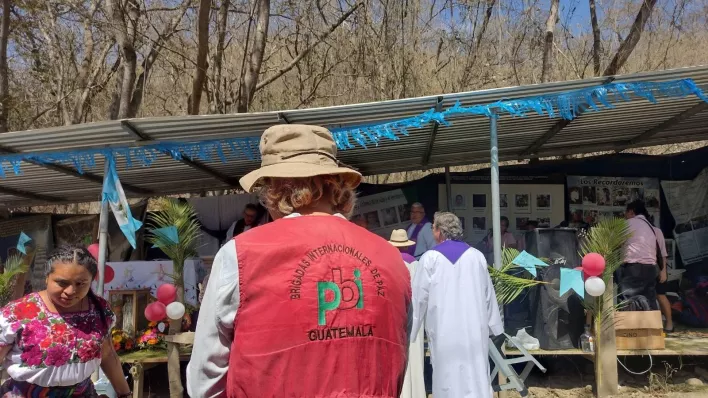
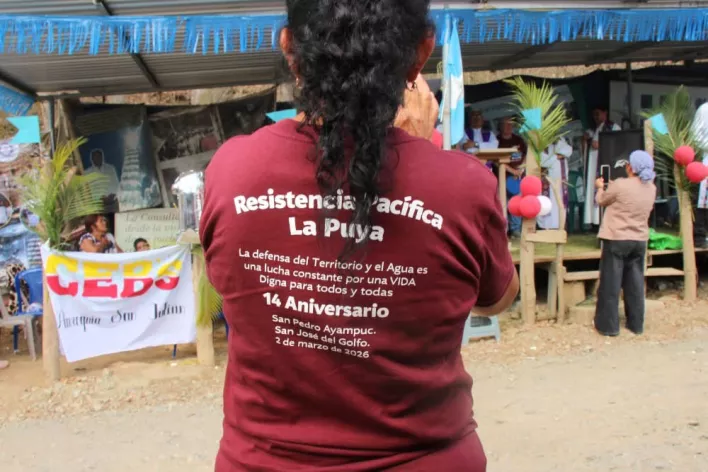
In March 2026, PBI Guatemala attended the 14th anniversary celebration of La Puya (pictured above and below) at which hundreds gathered to reinforce the fight against mining and corruption and to celebrate the December 2025 decision to dismiss the mining company’s lawsuit.
For a U.S. audience, La Puya’s experience raises an important question: What responsibilities do U.S. companies and institutions have when their activities affect communities, ecosystems, and human rights beyond our borders?
The people of La Puya remind us that environmental justice is inseparable from human rights. Their struggle is not simply against one mining project. It is a struggle for community participation, clean water, environmental health, and the right of future generations to determine what happens on their land.
Through the PBI-USA fellowship, Alexis hopes to amplify struggles like La Puya’s and help U.S. audiences understand that protecting environmental defenders is essential to confronting the climate crisis. When communities defend their water, they are defending life and their voices deserve international attention, solidarity, and protection.
Cover photo caption: Members of the Peaceful Resistance of La Puya have peacefully defended their water, health, and territory from the proposed Progreso VII Derivada mining project.
Source: PBI Guatemala.