
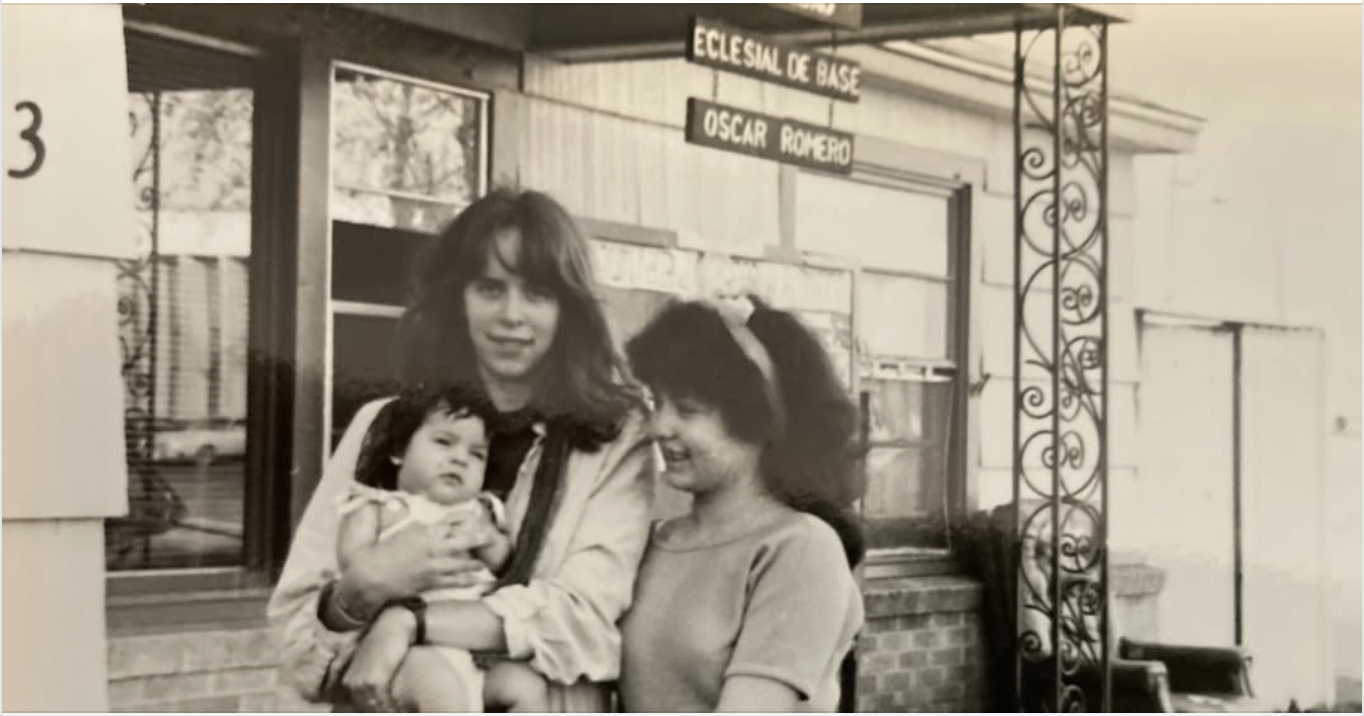
Karen Beetle has a long history working in non-violent movements for change, catalyzing her activism and organizing at age 17 in the arena of domestic affairs. Karen first got involved with PBI when she became a short-term volunteer for three months within Guatemala in 1985. Shortly after, she became involved in pioneering PBI’s Emergency Response Network (ERN) in 1987. Karen is currently working as a family therapist in Albany, New York.
Karen Beetle has always been inspired by non-violent movements for change, and the desire to contribute drew her to PBI’s Central America Project in Guatemala. At the time, PBI was accompanying leaders of Grupo de Apoyo Mutuo (GAM), a largely women-led organization that was speaking out powerfully and courageously in the wake of one of the most brutal military regimes in recent history that had disappeared more than 100,000 mostly indigenous Guatemalans.
“The fact that my U.S. Citizenship could offer protection to these courageous women was profoundly compelling.”
She corresponded with Aliane Hawkins from PBI’s Central American Project (CAP) in Toronto and within weeks was escorting the women of GAM from PBI’s house in Zona 11, Guatemala City.
“Every day afforded me new insight into and growing compassion for the complexity of international accompaniment and non-partisanship.”
Her time in Guatemala was filled with struggling to improve her Spanish, to maneuver in the political reality, to participate on a team, and to learn from the people who had lived for years under repression and terror.
“There was nowhere else I wanted to be.”
Coming back to the U.S. after her work with PBI in Guatemala in 1986 was a challenge. The intensity of our work stayed with Karen and she joined and then co-coordinated PBI’s Emergency Response Network – a network that generated telegrams and phone calls to back up our in-country accompaniment. She also contacted PBI’s CAP office and began the work that would lead to her staffing a PBI office in Albany, NY in 1987 that was supported by the CAP Toronto office and coordinated training and outreach for PBI volunteers. There, they developed an orientation/training model with a weekend to learn about PBI’s work followed by five days of training for potential volunteers. The ERN began training volunteers for the Guatemala team but went on to include training for the El Salvador and Sri Lanka teams as well.
Carolyn Mow, Liam Mahony and Karen had worked closely through the Syracuse Peace Council and nuclear facilities organizing in Upstate New York. Together they began designing and creating a base of support to launch PBI training and to develop the contacts that would lead to establishing PBI-USA two years later. Carolyn, Liam and Karen were joined by John Lindsay-Poland, Elizabeth St. John, Barbara Scott, Mary Link (from PBI’s International Office), Bob Siedle-Khan, Winnie Romeril, and others in creating the trainings, growing the ERN’s political strength, fundraising, and running speaking tours to get out the word about PBI’s model of accompaniment and the challenges faced by the non-violent movements they supported.
Carolyn and Karen Beetle both returned to Central America to work on the El Salvador team. Liam and Carolyn led a PBI delegation in Guatemala and Chiapas. All three went on speaking tours. Their first-hand experience as PBI volunteers and capacity to convey the challenges faced by the people they accompanied were profound catalysts for PBI’s growth in those early years. As activists and organizers, the team was well situated and deeply motivated to bring their skills and capacities to the development of PBI in the U.S. Both former and returning PBI volunteers were similarly motivated and well situated to join in spreading the word and keeping alive the voices of those who initially sought our accompaniment and who went on to win our hearts and minds.
“As I reflect on this work thirty years later, I am deeply appreciative of the integrity, commitment, and clarity of my PBI colleagues. I am grateful to have collaborated in such a meaningful way to live out our values and to support those whose lives were so unfairly shaped by political violence and repression. I am also grateful that so many hands have continued to carry out this work and that PBI is thriving today.”
Karen has remained committed to her life-long mission of supporting non-violent movements. More recently, she helped found Capital District Border Watch (February 2019) to respond with education and action to the human rights violations taking place at the border.